Tuesday, June 11, 2013
Deodatus Privatus Pius
Lists of names are somehow always interesting and if you are a teacher it is hard to resist the temptation to amuse the class, Rowan Atkinson-style, when you call out the register. Here in Dodoma they have some lovely names. Class lists (long ones, up to 75 per class) are in alphabetical order of first names. Spelling is not considered important so, as with Shakespeare, the same person can write their name in two or three different versions, even in the course of one day. Sign the attendance list for an exam one way, then write your name at the top of the paper a different way. Especially common is an optional -i or -y at the end of the name. Daniel or Daniely. Alfred or Alfredi. Class lists are prepared by the form teacher writing down each name as they hear it, so this can produce yet another variant. If you can't find Hadija under H look for Khadija under K. Francis? Check Phlancis. L and R are interchangeable. Can't find Leonard? Look for Reonald. The Old Testament provides some nice names - Ezekiel, Nehemiah, Samson, Shedrack, Meshack, and Abednego. Deific compound names like Godlove, Godheaven, Godlisten are common for boys. And one fairly average lad in Form II has the middle name God. For girls Happy and Happyness are very popular. Tanzania's German colonial era might be responsible for the occasional Adolph. To finish, here are a few of my favourites:
Filbert, Sixbert, Golden Leonard Tibu,
Rashid Hunter Charles, Deodatus Privatus Pius,
Godlove Goodluck Mahali, Wilbrod Renatus Mtuka.

Friday, February 8, 2013
Ex libris
By far the best thing we've achieved at the school here is the establishment of the library. I spend all my free time there and I still get a bit choked when I look round and see groups of students reading or studying quietly. We've got a decent number of books; all the text books previously kept untouched in a locked room have been released into the library, plus we have tapped into various charities which ship unwanted books from UK and USA. You don't get much choice about what you get, but books are books. We have a lending system which works fine now that pupils have finally believed that they are allowed to take books home. I'm just as keen a borrower as anyone. The cast-offs from the Britain and America are happy hunting grounds for me. Dumbing-down in the developed world could be the raising-up of the third. We have every Shakespeare play. Last week I read Measure for Measure. Not bad.
"But man, proud man,
dressed in a little brief authority,
Most ignorant of what he's most assured,
plays such fantastic tricks before high heaven
as makes the angels weep."
The angels have plenty to weep about in Tanzania.
It was about 20 years ago that I found I could read Shakespeare without a teacher telling me what it meant. Last week I opened “The Franklin’s Tale” and found I could understand it. What next? The Mahabharata in the original Sanskrit? I suppose I could try "Finnegans Wake" again.
Not all our books have come direct from UK or USA. I recently read “As Berry and I were saying” by Dornford Yates, with a book plate saying “Nairobi Club Library”, last borrowed 18 Mar 1957 and stamped Sold. Quite enjoyed it. Berry coming out with gems like “as much use as a belch in a barrage” which earned him a “You filthy beast” from his wife. Daphne called lots of people “filthy beast”, "filthy brute" or “filthy swine", entire nations in the case of the French and Germans. So, mildly entertaining but you hope no-one under 40 catches you enjoying it. Ernest Hemingway is another guilty pleasure, as he swaggers his way across East Africa shooting anything that moves. The school library has all the American classics: Fenimore Cooper, Melville, Edith Wharton, Hawthorne. I've just finished "The Scarlet Letter". Unconsciously I always thought it meant an incriminating epistle but in fact it's a big red A for adulterer the heroine is condemned to wear.
At home in my hotel I read on my Kindle. What a wonderful gadget. Predictably Mrs Scrooge mostly downloads old stuff ie Kindle Price $0.00. I also shamelessly use it as a free, if primitive, internet provider.Every so often it refuses to connect to Yahoo or Google or whatever and displays a polite but firm message saying that the Kindle's internet connection is supposed to be for buying books and I have overused it this month. So then I quickly try to mollify it by buying a couple of books with above zero prices. I like things set in Africa eg some of William Boyd's. The other day I bought one called "The Baobab Accord". It started with a few paragraphs written in a brilliant pastiche of the sort of African English so common here; a pompous, ungrammatical mish-mash of tenses and disjointed phrases. Here’s an excerpt:
“Martin then opened and proceeded to chair the meeting for which no minutes would be scribed, by welcoming everyone and thanks them for their attendance, and by not wasting too much time in the hot forty degrees baking sun. Martin got straight to the point of how to move forward with this brutal regime, alternatively what other options are at his disposal.”
I know the style only too well from English language newspapers, government propaganda, pamphlets, school text books and exam papers. Boyd had captured it perfectly. I read on…… Chapter one,…….Chapter two……”OK Boydie” I thought, “You’ve made the point, enough is enough, start writing properly.” But no, it continued, and it gradually dawned that this wasn’t the William Boyd. When I looked back I saw that the author was one William R. Boyd, probably a graduate of Dodoma University. When I went back to Kindle store I found some angry letters from other victims of this outrageous deceit. So, one of the very few drawbacks of the Kindle. I don’t think I would have been fooled if I had picked up “The Baobab Accord” in Waterstone’s. But, the one “Bookshop” in Dodoma sells only stationery and school text books, so I’m not going to start complaining about the Kindle.
Thursday, January 24, 2013
Bride price
Tuesday, January 15, 2013
Cześć
I am in Arusha for a few days and yesterday I followed up an extraordinary story that I stumbled on via a chance mention in an Ernest Hemingway novel. Did you know that 20,000 Polish people were relocated to various camps in East Africa in 1942? Their story is amazing, heroic and tragic. The Russians invaded Eastern Poland on September 17th 1939 and immediately began deporting undesirables and anti-Soviets. Over a million, including thousands of children, typical crime - being being a member of the Polish scouts, were transported to Siberia. In July 1941, after Hitler invaded Russia, they were "freed" and, emaciated and exhausted they made their way south via Central Asia to the Persian Gulf. Of those who made it, most of the men joined the British 8th Army later fighting at Monte Cassino. The British Government decided to send the rest, mostly women and children, many of whom were orphans, to East Africa. There were 22 camps, in Kenya, Tanganyika, Uganda, Rhodesia, and South Africa. One of them was in Marandellas where my sister and I went to school. The biggest, with 4000 inhabitants, was at Tengeru, about 10 miles East of Arusha.
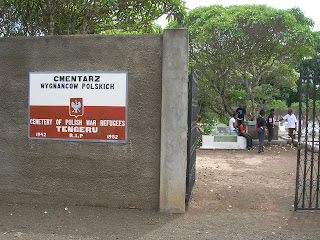 Yesterday I got the dalla-dalla to Tengeru, then a boda-boda (motorbike taxi) to "Polish Cemetery". It was an exhilarating, not to say scary ride up and down some very bumpy and steep tracks, but very scenic, through an area of agricultural parkland. I was dropped at the cemetery gate.
 The graves are mostly of a pattern and closely spaced, shaded by mature frangipani trees inside a high wall. The nice guardian told me that the cemetery is kept up by the Polish embassy in Nairobi. The camp closed in 1952 and, after a prolonged fight to avoid being sent back to communist Poland, the orphans eventually started new lives in Canada or Australia. The visitors' book showed quite a few Canadian and Australian Poles, some of them said "My grandmother is buried here", one said "I was born here".
 I walked back to the main road through what was the Polish farm and is now an Agricultural College and Research Station. I fancied that the farm buildings looked Polish, low and tiled with shutters at the windows.
The accommodation blocks also looked as if they were the original camp houses. I got most of my information from a book called Stolen Childhood, a first-hand account by Lucjan Krolikowski. There are photos of the children at various stages of their epic journey. It has also slotted a little piece into a jigsaw for me. A few years ago in a Tashkent museum I was puzzled by a school photo from the 1940's of a group of Polish children in national costume. Did they make it to East Africa I wonder? Five of the camps were in Tanzania. I might be able to track down the ones in Kondoa and Morogoro. If anyone out there has any more information I would love to hear it.
I walked back to the main road through what was the Polish farm and is now an Agricultural College and Research Station. I fancied that the farm buildings looked Polish, low and tiled with shutters at the windows.
The accommodation blocks also looked as if they were the original camp houses. I got most of my information from a book called Stolen Childhood, a first-hand account by Lucjan Krolikowski. There are photos of the children at various stages of their epic journey. It has also slotted a little piece into a jigsaw for me. A few years ago in a Tashkent museum I was puzzled by a school photo from the 1940's of a group of Polish children in national costume. Did they make it to East Africa I wonder? Five of the camps were in Tanzania. I might be able to track down the ones in Kondoa and Morogoro. If anyone out there has any more information I would love to hear it.


Sunday, December 2, 2012
Prison visiting
No pictures this time: you're not allowed to take photos of Dodoma prison or surroundings. I suppose they think you might use them to help a prisoner escape. Really I'd be surprised they wanted to escape. The prison is one of the pleasanter spots in Dodoma. It nestles under a rocky hill and once past the outer security fence you are in a pretty village of neat houses (staff accommodation?) and vegetable plots. The prison building itself is a walled fortress with an imposing gateway, but inside there is cobbled courtyard with shady trees and flower beds with the names of the various rooms, eg "Officer's room", picked out in flowers. The prisoners themselves, in their orange suits, bustle about cheerfully, carrying buckets in and out of the gate, sweeping, watering etc.
I've only been inside once, not as a prisoner I hasten to add, but to help recruit some cheap labour to put up a fence around a local primary school. (This is quite a regular thing here; you often see a group of them standing in the back of a pick-up truck with a couple of armed guards, all looking very happy to be having a day out somewhere.)
Signing in at the gate was a bit of a palaver, with a lot of saluting and clicking of heels, then we were shown into the governor's office where we negotiated our requirements, and checked the work party wouldn't include any dangerous criminals. The prison governor seemed a very nice man, but it was a bit disconcerting talking to him because two of the photos tacked up on the noticeboard behind him were of prisoners who had hanged themselves (we assumed) in their cells. So we kept our eyes everywhere but there and admired the various bits of craftwork on display. "Do the prisoners make these?"we asked. "Yes. Would you like to buy something?" "Yes. We would."
We were shown baskets, tablemats and doormats. The latter apparently are sent to the Comoros Islands where they are sold as local handicrafts. So if you go on holiday to the Comoros (does anyone?) and you buy a souvenir doormat it was probably made in Dodoma Gaol.
Tuesday, November 6, 2012
Family
I realised when I started planning my trip to Kigoma that I have some close relatives living just 25 kms away. We all have. Ninety chimpanzees live in Gombe Stream National Park, by the Burundi border north of Kigoma. Jane Goodall did, and still does intermittently, her research there. It’s on the lake shore and only accessible by boat. One of Ahmed’s “brothers” arranged for us to hitch a ride there in the National Park supply boat.
 Coming back we weren’t so lucky. We had to wade out to catch the 7am public boat in pouring rain and shove our way under a big tarpaulin being held up, by the 100 or so passengers, over themselves and their goods. But we were fairly lucky with the chimps. We had a whole day trekking the forest trails with our guide Isaiah and a trainee guide, Wilbrod. Lovely jungly plants and sounds, big butterflies flapping everywhere, yellow baboons and two big troops of Colobus monkeys swooping and whooping through the trees.
 They apparently thought we were chimps (thanks) who sometimes attack and eat them. We searched the hills, the valleys, the beaches, but no sign of chimps apart from their nests in trees.
 We were in two-way radio contact with a tracker (Isaiah ending every exchange with “Lodger”) but the tracker couldn’t find them either. Just when we had decided to give up and head up to a 25m waterfall, we came upon a mother chimp and baby, right on the path.
 I stood very, very still while she mooched past us and climbed a tree. The way she climbed, expertly but not at all monkey-like, made it completely believable that we share 99. whatever it is DNA with her. A bit later we saw another lone female. The “power shower “ of the waterfall set us up nicely for the hike back to camp. The swimming and snorkeling in the lake is also fabulous there although you have to watch out for baboons running off with your stuff while you’re in the water.
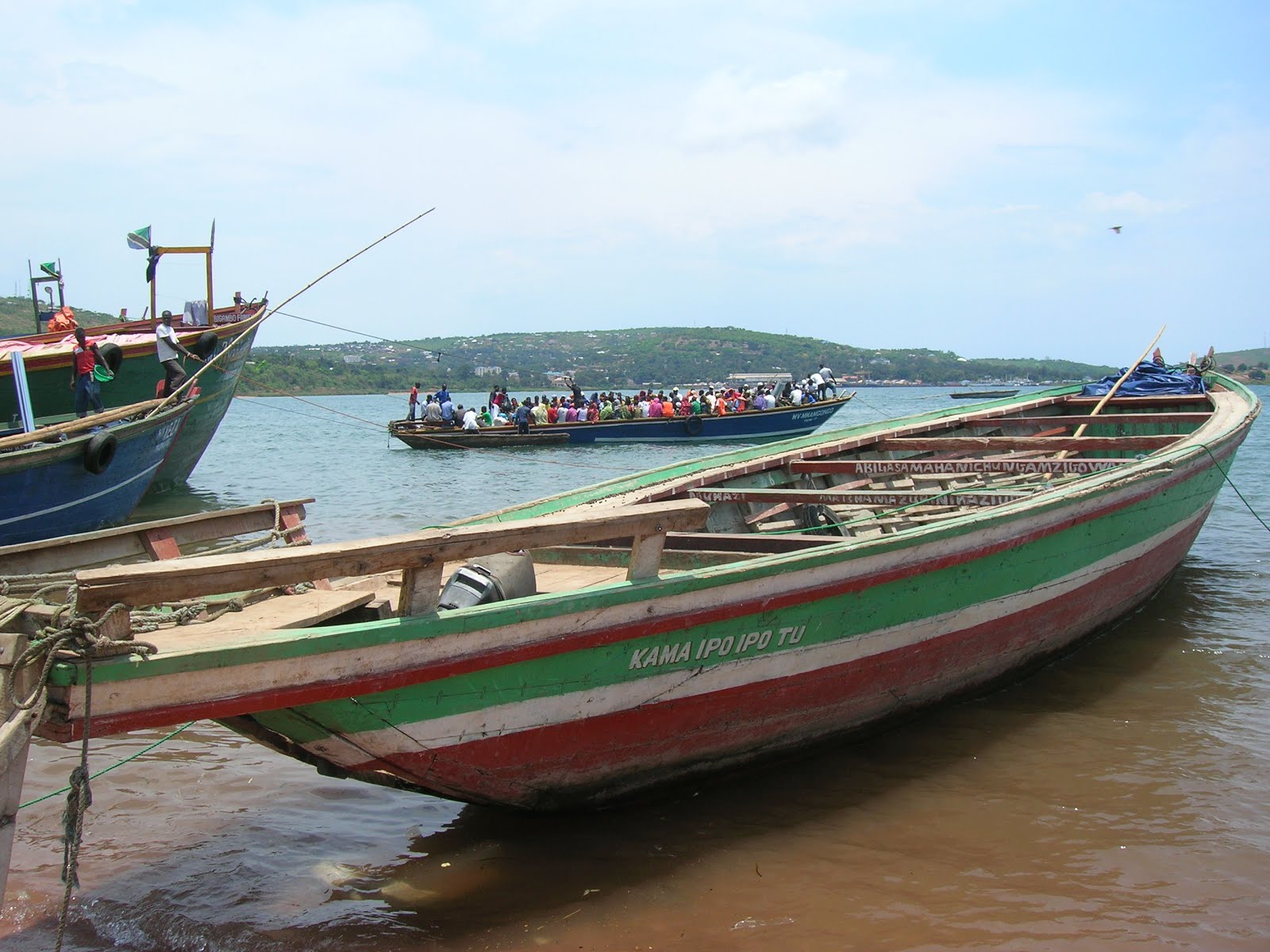
That’s almost it for the Kigoma trip, except for one more stroke of luck. The indomitable MV Liemba came into port while we were there.
I stood very, very still while she mooched past us and climbed a tree. The way she climbed, expertly but not at all monkey-like, made it completely believable that we share 99. whatever it is DNA with her. A bit later we saw another lone female. The “power shower “ of the waterfall set us up nicely for the hike back to camp. The swimming and snorkeling in the lake is also fabulous there although you have to watch out for baboons running off with your stuff while you’re in the water.
That’s almost it for the Kigoma trip, except for one more stroke of luck. The indomitable MV Liemba came into port while we were there.
 The Liemba was launched as the Graf von Gotzen in 1915 and scuttled by the Germans a year later. In 1924 she was pulled up from the bottom and renamed. She has been doing the 1000km round trip up and down the lake weekly ever since, the oldest operational passenger vessel in the world. Thanks to Ahmed’s mum’s first husband’s brother we managed to go on board and have a look round. The 3rd class seating area below decks didn’t look that inviting for a long voyage but the 1st class cabins above were the picture of shabby elegance. The ship’s wheel and binnacle on the bridge must have been original. Hmmmmm………………How to organize a trip on Liemba? Time to talk to Ahmed again.


Monday, October 22, 2012
Dr Livingstone, I presume
- Ujiji - For me all my life one of those places of legendary remoteness, like Timbuktu. It’s a great feeling to have finally actually been there. If anyone doesn’t know Ujiji is where Stanley found Livingstone. It’s a few miles south of Kigoma so it was the primary purpose of my long train trip. You can fly to Kigoma but that would have been no sort of way to get there. Walking would have been the best, but a slow train was a reasonable second best. Did Ujiji live up to expectations? Yes and no.
- I came from Kigoma in a dalla-dalla which dropped me at the edge of town and I walked down towards the lake. The town looked exactly as it should be and as described by Stanley.
 An important Arab-Swahili terminus in the 19th Century it has long since been overtaken by Kigoma. With its orderly streets of verandahed one-story houses and shady compounds reached by little bridges over the storm drains, it was easy to picture the famous scene: Everyone running out to greet Stanley’s expedition and him pushing his way through the crowds towards an unassuming figure waiting outside his own simple thatched house. We are told that Livingstone’s house no longer exists but I am surprised no enterprising local has “rediscovered” it. From Stanley’s sketch of the place you can see scores of likely candidates still in Ujiji. The tradition here is that the famous meeting took place under a mango tree at the western edge of town, where, I was told, the lake shoreline used to be. (It has receded a couple of hundred metres since then.) There is a monument purportedly commemorating the exact spot. Close by is a brand new and largely empty museum. So, the “yes” is the general look and feel of the town. The “no” is the concrete monument and the horrid intrusive museum.
 - Luckily, there is a wonderful Livingstone-Stanley museum near Tabora. When the train stopped there on the way home I raced out of the station and onto a boda-boda (motorbike taxi) shouting “Livingstone House, Kwihara, faster, faster” We left the town and jolted along a dirt road a few miles, then turned off onto a sandy track at a sign for “Livingstone’s Tembe”. At the end of the track stood a large isolated house with two huge mango trees in front. The boda-boda man picked up a little boy who said he knew the curator’s house and they brought him back a few minutes later.
 He unlocked the beautiful carved doors and in we went, me thinking of Stanley walking in, arm in arm with Livingstone saying, “Doctor, we are at last home”. I had spent about 20 minutes engrossed in the exhibits of Livingstone memorabilia when my phone rang. It was Ahmed saying, “Didn’t you get my message? The train leaves in 15 minutes.” Very sceptically and reluctantly I clambered back on the bike for the 25 minute ride back to Tabora station. Made it in plenty of time, of course; the train didn’t go for another 35 minutes.
- And, I still haven’t quite finished the story of the Kigoma trip. So, followers, you wait ages for a blog post, and then three turn up.
He unlocked the beautiful carved doors and in we went, me thinking of Stanley walking in, arm in arm with Livingstone saying, “Doctor, we are at last home”. I had spent about 20 minutes engrossed in the exhibits of Livingstone memorabilia when my phone rang. It was Ahmed saying, “Didn’t you get my message? The train leaves in 15 minutes.” Very sceptically and reluctantly I clambered back on the bike for the 25 minute ride back to Tabora station. Made it in plenty of time, of course; the train didn’t go for another 35 minutes.
- And, I still haven’t quite finished the story of the Kigoma trip. So, followers, you wait ages for a blog post, and then three turn up.


Thursday, October 18, 2012
The Central Line
Hello again, followers. Long gap between posts; I've been waiting for something interesting to happen in Dodoma. Or just something to happen. Ever since I got here I have been attracted to the Railway Station and the sight and sound of the occasional big old train arriving or departing. Dodoma is on the Central Tanzanian Railway, built by the Germans just before WW1. It follows one of the old caravan routes from the coast to Lake Tanganyika at Kigoma, the path tramped by Livingstone, Stanley, Burton and Speke, Emin Pasha - all childhood heroes of mine. My favourite reading here (on my Kindle) is by or about those guys, their foolhardy curiosity and sheer guts, with some disturbing glimpses of how little things have changed. One thing has though. In 1871 it took Stanley 5 months to get from Dodoma to Kigoma. (His route must have taken him through Dodoma but, then as now, it wasn’t worth a mention.)Thanks to the railway I did it in 28 hours last week. Getting a ticket wasn’t easy. There are two trains per week with 12 First Class berths per train. Most, sometimes all, of these are reserved for “staff” (TIA). There is no 2nd Class and I was advised that even I (“Well, this is fairly grim, Galloway, so I suppose you’re loving it”) might not cope in 3rd Class. By a stroke of luck I happened to mention my ticket quest to Ahmed who helps in the gym at the Dodoma Hotel. He said “I’m from Kigoma. The station master there is my friend. I’ll get the tickets. In fact I’ll come with you, if you pay.” 180 kilobob later the deal was done and we set off, a trifling 3 hours late, on Saturday morning.
 The accommodation wasn’t deluxe. We were sharing the 2-berth compartment with Ahmed’s other friend, Mr Siwingwe, the train supervisor, and his fiancée (who seemed to be met by her husband and 4 children when we got to Kigoma!) Comfort was further compromised by 4 sacks of flour, 2 of potatoes, 16 buckets and various other transportables. Mr Siwingwe’s official duties meant that there were plenty of comings and goings at our door. At Manyoni two women with babies and eight of those big striped nylon carry-alls pushed their way in. After a bit of a shouting match they left, but their luggage stayed in.
Mid-afternoon we stopped at Saranda for lunch. Everyone piled off straight into an outdoor trackside “restaurant” the whole 17-carriage length of the train, all grilling and frying and stewing.
The accommodation wasn’t deluxe. We were sharing the 2-berth compartment with Ahmed’s other friend, Mr Siwingwe, the train supervisor, and his fiancée (who seemed to be met by her husband and 4 children when we got to Kigoma!) Comfort was further compromised by 4 sacks of flour, 2 of potatoes, 16 buckets and various other transportables. Mr Siwingwe’s official duties meant that there were plenty of comings and goings at our door. At Manyoni two women with babies and eight of those big striped nylon carry-alls pushed their way in. After a bit of a shouting match they left, but their luggage stayed in.
Mid-afternoon we stopped at Saranda for lunch. Everyone piled off straight into an outdoor trackside “restaurant” the whole 17-carriage length of the train, all grilling and frying and stewing.
 This was repeated on a smaller scale at most of the stops, many of them very lovely aging German-style station buildings in a compound of solid old mango trees, palms and frangipanis. In between halts there was always the buffet car, which served basic meals and cheap, if warm, beer. The train rattled on through the bush, with no other sign of human activity for long stretches. Sometimes a dusty track ran alongside and it was easy to picture a long caravan of porters, guides, askaris and the explorer in his pith helmet or battered old peaked cap, all trudging along. Or, coming the other way, a pitiful line of fettered and chained slaves plodding their sad weary path to the coast.
 The scenery got gradually greener and at last we had our first view of the Lake. Just after 3pm Sunday afternoon we rolled into Kigoma, whose magnificent terminus would not look out of place on Lake Geneva rather than Lake Tanganyika.
 Four days later the train back set off six hours late. A fellow passenger told me the trains get later and later until departure time catches up with the time of the next train, so they cancel one and the process starts again. Our train broke down in the middle of the bush for an hour or so in the late evening. No one seemed bothered, quite the reverse. Bonfires were lit beside the track and groups of passengers stood around eating, drinking and laughing, till the whistle finally blew again.
 There were two backpackers/volunteers from Berlin in the compartment next to ours and we had a bit of a party the second night. First topic of conversation was “Is the train German?” Franck said the locomotive was, but not the rolling stock. He was a former graffiti artist and boasted specialist knowledge of train design. After that we discussed Tanzania and its problems, with increasingly incoherent contributions from Vincent, our neighbour on the other side. His main argument was that Tanzania was a “foolish” country. When Vincent was finally incapable of getting his tongue round the word “foolish” any more we decided to pack it in and get some sleep. At 8 o’clock on Saturday morning the train stumbled into dear old Dodoma and we stumbled off the train.
I’ve spent so long describing the journey there and back, which admittedly took up a large percentage of the trip, that the story of what I did when I was there will have to wait for another post.
There were two backpackers/volunteers from Berlin in the compartment next to ours and we had a bit of a party the second night. First topic of conversation was “Is the train German?” Franck said the locomotive was, but not the rolling stock. He was a former graffiti artist and boasted specialist knowledge of train design. After that we discussed Tanzania and its problems, with increasingly incoherent contributions from Vincent, our neighbour on the other side. His main argument was that Tanzania was a “foolish” country. When Vincent was finally incapable of getting his tongue round the word “foolish” any more we decided to pack it in and get some sleep. At 8 o’clock on Saturday morning the train stumbled into dear old Dodoma and we stumbled off the train.
I’ve spent so long describing the journey there and back, which admittedly took up a large percentage of the trip, that the story of what I did when I was there will have to wait for another post.


Tuesday, April 24, 2012
Pat and Passel
VOICE! This is what Tanzanians shout at someone making a speech in English if they are speaking too quietly. Like everywhere else in the non-English-speaking world, knowledge of English is seen here as the Open Sesame to wealth and happiness, so I give an increasing number of informal lessons in my spare time. I'm not a very good English teacher (I barely scraped a pass in my CELTA (Tefl)course) so I don't charge anything. The idea of doing something for nothing is considered pretty strange here. Much more popular is the idea of doing nothing for something.
Anyway, at first I firmly corrected such usages as Voice! and idiosyncratic pronunciations such as cloth-es. Now I don't. I have decided that what my pupils need to know is Tanzanian English (Tanglish?); the chances of them getting to Britain or the US and chatting away with the natives being sadly, but realistically, zero. So now I happily respond to such greetings as "How is your condition?" with the expected "Fine", even though it sounds as if a not-very-close colleague wants to know about the embarrassing itching. Another slightly unnerving morning greeting is "How was the night?" How much detail do they want? Don't panic. "Fine" or "peaceful" is enough. Tanglish is certainly not one of those "Him fella belong Mrs Queen" pidgin dialects. The grammar is fairly standard but some of the vocab is strange or quaint. Some Tanglish phrases are so popular that they pop up in a stream of Swahili. When parliament is sitting I eat my dinner to a TV background of MP's debating in Swahili, their speeches peppered with "...part and parcel..." and "...doing his level best..."
One of my little classes: Ramadhani and Modestus, studying Financial Management at St John's University and Wu Sheng Nan who is from China and works as a guard at possibly a construction company near the Dear Mama Hotel. We meet once a week at the Hope Corner Bar.
 All three want to focus on fluency in spoken English. The two students are hampered by their limited vocabulary and slow sentence construction but their pronunciation isn't too bad, apart from the usual Tanzanian short("shot") vowels and staccato delivery. Mr Wu, on the other hand, has a large vocab and his grammar is pretty good too. But. We can never understand what he is trying to say. Most of the lesson consists of a game of Give us a Clue/Charades with the three of us trying to guess the phrase. I had Mr Wu down as a religious nutter when he first approached me because told me he was God...... Dear Mama God. It's all a far cry from my CELTA course in Covent Garden where we were teaching topics like "Leisure time interests" or "Where I go for my holidays" to assorted Europeans. But at least I don't have to grapple with my Nemesis, the interactive whiteboard. The only technical hitches at the Hope Corner are being plunged into darkness by a power cut. And it's nice to be appreciated. This text from Ramadhani: "Thanks for your kindly heart to help people. God bless you. Gud night"

Thursday, March 29, 2012
Motorcycle Diaries
Three days ago Mhina, one of my colleagues, asked for a word with me. "It's a secret". So we stepped outside and he told me that a friend of his, Dickson, who lives in a village about an hour away, had found "an asset". (Mhina is the commerce and book-keeping teacher so a lot of his vocab is subject specific.) He said it was something old - maybe English or German. It was neat timing because I've just finished a novel called "The Book of Secrets" by M.G. Vassanji. The eponymous "book" is a diary lost by a colonial officer in 1914 and found in the 1980s by a teacher in Tanzania. So I asked Mhina to find out more. Over the next day or two I learnt the following: The village is called Sejeli. In fact Mhina did his last two years of primary school there, living in his uncle's house because his father heard that the school was better than the one in their village. Dickson is a former classmate. That was all fairly clear, but the information on the asset itself was tantalisingly confused. It is in a building/It is buried in open ground. It is a metal box/It is a machine. It has English or German instructions/directions. There are two assets. There had even been a third but they had shown that to some other wazungu who had taken it away. I decided I could spare a few hours and a few thousand shillings so at 8am on Friday I was waiting for Mhina at the bus station. We got a bus to Mbande on the road to Dar es Salaam where Dickson and another man met us. A dirt road running North-South crosses the main road at Mbande. Dickson first pointed Southwards towards a fairly distant hill and said one asset was on top of that "mountain". Then he pointed North and said the other asset was 10km up that road, beyond Sejeli which Mhina said was one or two km away. But how to get to either of them? The main problems being lack of any suitable transport and not enough money to pay for it anyway. Eventually we settled on the Northern option because a man with a motorbike had some unintelligible (to me at least) connection/claim to that one. The piki-piki man was summoned, we handed over 10,000 shillings, I clambered up behind him, Mhina got up behind me on the luggage rack, and off we went. 30 minutes later we passed through Sejeli and Mhina pointed out his old school and his uncle's house. I pointed out that it was a lot further than 2 km. Mhina said "Sorry, I don't know how to use kilometres." After another hour in the saddle it became clear that none of them did. We travelled along the red dusty track, passing occasional ox carts, bicycles or other piki-pikis, weaving our way through herds of livestock, crossing dry riverbeds, the driver sometimes having to "paddle" with his legs, crossing wet riverbeds, and two more villages. It should have been quite enjoyable - lovely open bush dotted with thorn and baobab trees.
 But squashed between the driver and Mhina, having to sit slightly leaning back, became excruciatingly uncomfortable, and of course the lovely African sun was beating down all the time. There were a few shouted conversations across me and then Mhina would point to a hill and say "It's there". But we always just roared on past. I began to wonder how far a bike can go on one tank, and hoping it was about as far as we had come. Then after 2 hours we stopped and asked two ladies the way (I think). We then pulled into a farmstead where Mhina and I detached ourselves with difficulty and tottered over to a shady spot under a tree. We shook hands with the family and after more talk we got back on, this time with four of us, one of the farmers (luckily quite a small chap) perched on the petrol tank. We journeyed on, with our pilot pointing this way and that; the track became a path, weaving through tall maize, the leaves whipping our legs. Then we left the path and bumped across the bush until we ground to a halt in a thicket at the base of a small rocky hill. We fought our way up through thick and thorny bushes with the two locals arguing about where to go. The p-p man said it was two years since he had been there.
 After a bit of backtracking we eventually came out on a rock ledge under an overhang and we flopped down to admire the view.
It was exactly the kind of place where you find cave paintings and sure enough when I looked round the rock was covered with white geometric doodles and stylised animals (see Ageing Rock Artists blogpost). Leading down from the painted surface was a tunnel-like cave entrance, narrow and carpeted with bat poo - the sort of opening a potholer would describe as "a nice little feet first slide".
After a bit of backtracking we eventually came out on a rock ledge under an overhang and we flopped down to admire the view.
It was exactly the kind of place where you find cave paintings and sure enough when I looked round the rock was covered with white geometric doodles and stylised animals (see Ageing Rock Artists blogpost). Leading down from the painted surface was a tunnel-like cave entrance, narrow and carpeted with bat poo - the sort of opening a potholer would describe as "a nice little feet first slide".
 Which is exactly what piki-piki man proceeded to do - a few startled bats flew out as he slid in - armed with my torch.
 "What's down there?", we shouted. He said there was a sort of cement frame on some rocks. It didn't sound worth the trouble so the rest of us gave it a miss. P-p man then popped up from another unpleasant-looking hole on the other side of the rock, and dusted himself down. Mhina and I decided that that was probably it as far as assets were concerned so we scrambled back down the hill to the piki-piki, except that we couldn't find the piki-piki; we had been all round the rugged rocks and lost all sense of direction and, in the face of all evidence to the contrary, Mhina and I just assumed the local guys knew what they were doing.
 We blundered about for an hour or so before Mhina spotted a flash of sunlight reflected from a wing mirror.
 Then we couldn't find the others, we coo-eed and hollered for ages before first the diminutive farmer then p-p man finally emerged. Readers, you are not going to believe this next bit; p-p man couldn't find the key. He was sure he had it when he heard our shouts so we spent another half hour searching the area before it turned up under the bike. So at 5pm we finally set off back. A lovely long trip in the late afternoon light, first to drop off our pilot, then the long haul to Sejeli. Halfway there the question of how far the bike can go on one tank was settled and Mhina and I sat by the road eating sugar cane while the driver puttered off to find some fuel. Then we got going again and called in to see Auntie and Uncle who gave Mhina a big bag of maize (was this the real reason for the trip?) At 7pm we were back at the main road where Dickson was waiting for news and neither Mhina nor I really knew what to say to him. As we squeezed into a dalla-dalla to get back to Dodoma, Dickson thrust a little package with a few mineral pieces into my hand and asked me to find out if they were precious stones. I got home at 8.30, burnt to a crisp, wind-blown, hungry, thirsty and bemused. If you have read all this expecting something more interesting I can only apologise. That is how it is here. If you try to get to the bottom of things you just go mad. OK. That's it for now. Must go out and talk to myself with my pants on my head and two pencils up my nose.


Monday, January 23, 2012
I'm back
I was away for exactly a month and the place looks completely different – all green and luxuriant everywhere. The maize which wasn't even planted when I left is now as tall as me.
 And the mozzies are biting. They seem unconcerned by the “Deet”iest repellent, though I managed to remove a patch of varnish from my dressing table by putting the bottle down on the surface. They even bite through clothes, one layer anyway, so you have the choice of chemically dissolving your own skin or wrapping up well and drowning in your own sweat. Lovely. A quick word on the rest of my trip. Addis Ababa was a bit of an odd few days. I was adopted by a born-again Christian family when I mistakenly climbed into their family minibus thinking it was the local airport transport. It turned out that they had lived in Tanzania for 7 years. Jan 7th is Ethiopian Christmas (because they use a version of the Julian calendar) so I had Christmas dinner with them. Injera of course, followed by panettone, courtesy of Mussolini. Thence to Nairobi which I thought was a really nice friendly, lively city, nothing like I expected from its dodgy reputation. Being a regular user of Lonely Planet's Thorn Tree forum, I had to go on a pilgrimage to its original location (they're on their third tree) in the cafe of the New Stanley Hotel. And asante sana to Katie Donaldson for looking after me so well. Now it's back to the middle of nowhere for the next few months at least.

Monday, January 2, 2012
Out of Africa
Purists, stop reading now. Elaine's not in Dodoma. School broke up for the holidays on December 8th and starts again on January 9th. There was some uncertainty about the dates until the week before and in the end I had a few days to spare before my flight to London from Dar es Salaam. Friends suggested a trip to Zanzibar but I didn't think I would be able to relax with 60km of sea between me and the airport. So I went to Bagamoyo, historically the port for Zanzibar, terminus of the slave routes to the interior, starting point for Livingstone, Stanley etc and, with its dhow port and decaying Arab merchant houses,
 arguably a small-scale, quieter, scruffier version of Zanzibar. A very enjoyable couple of days, nosing round the sites and swimming in the startlingly warm Indian Ocean.
Then home to London for a slightly early Christmas. Now I'm making my slow way back. Currently sitting by the Red Sea between Nuweiba and Taba at the camp of my old friend Yasser. As usual I'm the only guest, possibly the only one from Nuweiba to Taba. I've forsaken my favourite old Housha (Beach hut) for Yasser's new Bent House.
arguably a small-scale, quieter, scruffier version of Zanzibar. A very enjoyable couple of days, nosing round the sites and swimming in the startlingly warm Indian Ocean.
Then home to London for a slightly early Christmas. Now I'm making my slow way back. Currently sitting by the Red Sea between Nuweiba and Taba at the camp of my old friend Yasser. As usual I'm the only guest, possibly the only one from Nuweiba to Taba. I've forsaken my favourite old Housha (Beach hut) for Yasser's new Bent House.
 (Egyptians always have trouble with p's and b's. It took me ages to realise why his black and white dog was called Banda). It's been great checking out some old haunts. Egypt is such a fabulous destination; the picture-book scenes of peasant farming by the Nile, the weird desert moonscapes, and the bustling towns with cars, donkey carts, boys on bicycles with impossible loads of bread on their heads, and men in galibiyas running about shouting. Moustaches range from Hitler to Handlebar and Hercule Poirot would not look out of the ordinary if he decided to take another Nile cruise now. The Winter weather is very pleasant although it gets cold when the sun goes down. I've been catching up on sleep; going to bed early and not getting up till the sun has had a chance to warm things up. Exactly the opposite to Bagamoyo, which was stinking hot. I had to drag myself out early to do my sight-seeing before the midday heat. London was just freezing all the time; perfect for sitting indoors in cosy Christmassy rooms, quaffing, scoffing and opening prezzies, thanks to my lovely family and friends. Next stop: Addis Ababa, hoping to celebrate Leddet (Orthodox Christmas), followed by Nairobi - a very old haunt - I was last there in April 1962.


Saturday, December 3, 2011
Rain
Well I suppose the rainy season has started. It has been getting hotter and hotter but also cloudier and cloudier, with some thunder and lightning in the evenings. We had a couple of showers; then last Saturday night it rained hard. The place didn't turn green overnight.(I didn't actually believe it would). But if you get down and look you can see lots of little green shoots bursting through where there was previously bare earth. A couple of large lakes have appeared by the main road, the bridges which formerly crossed dry gullies are now crossing sluggish brown rivers and the ditch I have to negotiate on my path to school is now an even more difficult water hazard. I have had to relearn the pitfalls of my route. Various sand banks have shifted so some sections that were difficult have now had the sand swept away but others have suddenly become treacherous.
But the most noticeable thing is that suddenly everyone has got their mattocks out. It's a jembe in Swahili. We used to call it a khasu in Malawi.
Pieces of land that I thought were just waste ground are now nicely turned over, the red earth ready for the maize or sorghum. There are no discernible boundaries and no fences. Grazing animals are always kept within bounds by a shepherd or cowherd.
The rain has also brought out the local wildlife, especially scorpions. I have become wary of pupils approaching the staff room carrying containers with holes punched in. The National Exam in Biology often includes a classification exercise involving scorpions so the school tries to build up a stock of them while they are plentiful.
There has been no rain since Saturday and as I write the sun is shining in a blue sky. These are the short rains, so maybe that's it.
But the most noticeable thing is that suddenly everyone has got their mattocks out. It's a jembe in Swahili. We used to call it a khasu in Malawi.

Pieces of land that I thought were just waste ground are now nicely turned over, the red earth ready for the maize or sorghum. There are no discernible boundaries and no fences. Grazing animals are always kept within bounds by a shepherd or cowherd.
The rain has also brought out the local wildlife, especially scorpions. I have become wary of pupils approaching the staff room carrying containers with holes punched in. The National Exam in Biology often includes a classification exercise involving scorpions so the school tries to build up a stock of them while they are plentiful.
There has been no rain since Saturday and as I write the sun is shining in a blue sky. These are the short rains, so maybe that's it.
Friday, November 25, 2011
Red Tape
A local friend, we will call him Lucas, offered to come with me on my latest round of visits in my quest for a work permit. He is a successful businessman judging by his big new car and he thought he might have a few useful contacts in the various government offices. On the appointed day, as I climbed into the car, he said something had cropped up in one of his properties and would I mind if we called in there first. The place was only a few streets away from the Immigration Office. It was a small rice-milling plant and it was clear there was "trouble up at t'mill"; a confused crowd of workers outside supervised by two policemen, as usual a fat old one and a slimmer young one. The problem turned out to be a surprise visit from the Health and Safety people who had made an inspection and closed the place down on the spot. Lucas spoke briefly to the policemen and we got back in the car. We drove round the corner to one of the covered market buildings where the H and S offices were upstairs. Some of the local government offices here are positively palatial but this one wasn't. It was a small room tucked in under the roof, with bare dirty walls, not even the usual framed photo of President Kikwete. There were two wooden tables Nos DMC/SKM/OD-T3/0033 and DMC/SKM/OD-T3/0034 and two tall metal lockers Nos DMC/SKM/IR-CU-7/0029 and DMC/SKM/IR-CU-7/0030. Every chair, table, cupboard, everything, is numbered in Tanzania, the figures neatly painted in white. I've just stood up and checked the chair I'm sitting on; it's No. N/N/CH/0053. Anyway, the only other things in that room were two large bowls of mangoes (not numbered) on the floor. A smartly dressed woman sat behind table 33 and the two policemen and a tough-looking guy in jeans and T-shirt sat behind 34. Lucas and I were told to sit on a low bench (?.....B1/01?)
"Linguistically challenged" Elaine could only pick out a couple of words of the prodeedings - one of them "choo" which is toilet. Lucas told me later that was apparently blocked, plus the workers weren't wearing masks or protective clothes. He says they find them unbearably hot and I can believe it. The lady produced a letter and she, the tough guy and the fat policeman kept pointing at various details so it was obvious that the shortcomings from a previous visit had not been addressed. There were stern words and a lot of finger stabbing on tables 33 and 34. Lucas, who is usually quite assertive, sat quietly, giving a few meek answers. Except when his phone went off in which case he ignored them while he answered the call. As did everyone else present. The thinner policemen was occupied with his mobile throughout, sometimes interrupting to borrow his colleague's phone as well. Various people came and went, newcomers blythely greeting everyone individually with requests for news of children, home etc. They just raised their voices above the admonishments of the current speaker then sat down and took their turn to have a go at Lucas. But every so often, in the middle of all the tough talk, everyone, including Lucas, burst out laughing for a while, then got back down to the telling off. After about an hour the fat policeman got out a big ledger and entered some details. Then Lucas and I were free to go, but accompagnied by the tough guy.We drove to the Immigration Office, spoke to an official with our minder hovering behind us. Then we were sent to the Regional Administration Office - ditto. There they palmed us off with the usual promise to ring tomorrow. I jumped into a dalla-dalla to go to school. Lucas drove off in the car with tough guy and I haven't seen him since.
No pictures this week. Photography is not allowed in and around government buildings. And I was even warned not to take pictures in the market without a permit. The local people themselves are also not keen to be photographed. You have to be discreet or negociate a deal, which is really not my thing; that's why I'm not a business woman, and will probably never get my work permit.
"Linguistically challenged" Elaine could only pick out a couple of words of the prodeedings - one of them "choo" which is toilet. Lucas told me later that was apparently blocked, plus the workers weren't wearing masks or protective clothes. He says they find them unbearably hot and I can believe it. The lady produced a letter and she, the tough guy and the fat policeman kept pointing at various details so it was obvious that the shortcomings from a previous visit had not been addressed. There were stern words and a lot of finger stabbing on tables 33 and 34. Lucas, who is usually quite assertive, sat quietly, giving a few meek answers. Except when his phone went off in which case he ignored them while he answered the call. As did everyone else present. The thinner policemen was occupied with his mobile throughout, sometimes interrupting to borrow his colleague's phone as well. Various people came and went, newcomers blythely greeting everyone individually with requests for news of children, home etc. They just raised their voices above the admonishments of the current speaker then sat down and took their turn to have a go at Lucas. But every so often, in the middle of all the tough talk, everyone, including Lucas, burst out laughing for a while, then got back down to the telling off. After about an hour the fat policeman got out a big ledger and entered some details. Then Lucas and I were free to go, but accompagnied by the tough guy.We drove to the Immigration Office, spoke to an official with our minder hovering behind us. Then we were sent to the Regional Administration Office - ditto. There they palmed us off with the usual promise to ring tomorrow. I jumped into a dalla-dalla to go to school. Lucas drove off in the car with tough guy and I haven't seen him since.
No pictures this week. Photography is not allowed in and around government buildings. And I was even warned not to take pictures in the market without a permit. The local people themselves are also not keen to be photographed. You have to be discreet or negociate a deal, which is really not my thing; that's why I'm not a business woman, and will probably never get my work permit.
Monday, November 21, 2011
Oscar Wilde, Sid Vicious and me.
Tanzanians and non-Tanzanians alike think it's weird that I live in a hotel. There are pros and cons (don't think the Nam would have suited Oscar or Sid) but on balance I prefer it. Most of my Wazungu friends live in compounds but in my mind compound is always preceded by the word prison. I could rent a house, but with a house would come responsibility. I would have to have a staff of at least two - a guard and a house servant. I would also be at the mercy of Tanesco (Tanzania Electricity Supply Co) and its frequent power cuts. Here at the Nam we have a generator, when it's working and when we've remembered to buy some Diesel. And we usually have enough water pressure for a shower. The hotel has a good laundry service but I don't use it much. It's very dusty and windy here and your clothes get nice and dirty. It's hugely satisfying seeing the water coming out like oxtail soup as you wash your things. Proper brand name soap powder in boxes is expensive here but anonymous black plastic bags filled with perfectly serviceable stuff is sold very cheaply by the "barrow boys". Street restaurants always have a saucer of "Omo" for you to dip into when you wash. Not very kind to your hands but very thorough. I don't have an iron. My loyal followers know how much I like ironing (a lot, seriously). The Nam Hotel is in Area C (suburb of Dodoma). Also in Area C is MAF which stands for Mission Aviation Fellowship. I love MAF; not least because they have a fleet of light aircraft (well, two I think) which serve remote mission stations and you can sometimes get a spare seat cheaply and escape from Dodoma for a few days. Even better they have an iron and ironing board in the sitting room of their hostel. I sneak in with my ironing on Sundays when everyone's at church. Oh yes, I'm well up there with Wilde and Vicious, flouting the rules and having a high old time. So for now anyway I'm happy where I am. The staff are friendly and when Parliament is sitting we have a sprinkling of the nicer type (ie not extravagantly lodged in the New Dodoma Hotel) of MP staying, which makes for some interesting company. And the balcony/corridor outside my room has a lovely view of Lion Rock.

Sunday, November 13, 2011
Ageing Rock Artists
Lonely Planet describes Central Tanzania as "Well off". That's not the impression you've given us, I hear you cry. Keep reading: "Well off most tourist itineraries..." This weekend Jan and I hit the tourist trail and visited the Kondoa Kolo Unesco World Heritage Rock Paintings. Listed as "Around Dodoma" in the Tanzania Footprint Guide, they are in fact 200 km up the Great North Road (Capetown to Cairo)."Great"in length only. The tarmac gives out on the outskirts of Dodoma and long sections of it are only suitable for 4 x 4's. Therefore, sadly, not suitable for the Mrisho Investment bus which juddered away from Dodoma bus stand at five past noon on Friday. (Warning Readers. Do not invest in this bus.) Elaine and Jan were fairly comfortably installed in the front row, a bit short of leg room owing to the big tool box pushed under the seat. An hour later the reason for the tool box's accessibility became clear. A hideous graunching crunch from the engine was swiftly followed by a whooshing sound of fluid being released from somewhere and an exchange of worried comments between the driver and the guys variously standing and sitting in the doorway, on the steps and up at the windscreen. We clattered to a halt, all the passengers immediately piled off as if it were a scheduled comfort stop and headed off into the bush or sat under the shade of the nearest baobab tree, chatting away happily. Meanwhile the bus driver and the bus "fundi" watched by the customary circle of interested blokes, squatted down in the road and carefully fashioned a gasket or something out of an old Konyagi carton. An hour and a half later and we were on our way, and looking forward to a nice cold Safari beer in Kondoa when the bus lost all power going up a hill and it was everybody out again. In short, which the journey wasn't, we ended up getting out and walking up two more hills and waiting while they fixed the bus. The four hour journey stretched to eight but we finally reached a dark and dusty Kondoa. Not to worry - our Swahili got some practice - and we found rooms OK at the New Geneva Hotel in Kondoa (always some Swiss connection when Jan is around). The Geneva had a very lengthy registration form which included "Tribe". I put "Angles", which I wasn't that happy with. Suggestions for next time please, Readers. Next morning we negociated a taxi for the day (130,000/-) drove the 20km to Kolo where we looked round the little museum and picked up a lady  guide(30,000/-), and then headed for the hills. It was beautiful weather of course and each site involved parking up and climbing the last bit. Those cavemen certainly picked some nice spots and the views were gorgeous. The rock art was pretty good too; red spindly humanoids and realistic, recognisable animals in Kolo sites B1, B2 and B3 and black and white abstract trance dance geometric shapes at nearby Pahi.
  Apart from one "pancha" our taxi coped well, bumping its way along tracks (aka the Great North Road) and across dry river beds, and our bus on Sunday morning got us back to Dodoma in an impressive 3 hours 45 minutes.


Sunday, November 6, 2011
575 New Teachers
St John's University ("A Centre of Excellence for Developing Humankind Holistically to Learn to Serve") had its Graduation Day yesterday. They like to do this kind of thing properly in Tanzania. The Prime Minister, the Hon. Mizengo Kayanza Peter Pinda (MP) was Guest of Honour; a military band was in attendance; seven or eight large marquees had been put up on the sports field and festooned with ribbons; and the town's tailors, seamstresses and milliners have been busy in the last few weeks making gowns, hoods, mortar boards and other arcane academic accoutrements. For the 1100 "Graduands" including two of my colleagues, the day started at 8.30 with rehearsals and "preparation". I arrived about one o'clock and seeing the crowds I decided it was payback time for all the shouts of "HEY MAZUNGU!" I get as I go about my daily life here.I latched onto a couple of Australian St John’s lecturers and strolled confidently past the security and found a seat in a marquee near the VIP dais. Meanwhile the other family and friends were back behind ropes, standing squeezed together under the trees in the patches of shade.
It was soon clear that there was something very unTanzanian about the arrangements when proceedings started 20 minutes ahead of schedule. The band marched in – ceremonial baton twirling – followed by the solemn procession of PM, Chancellor, Vice-Chancellor, Acting Deputy Vice-Chancellor, Proctors, Deans of Faculty, Chaplains, lecturers, all resplendent in gowns, hoods and those puffy Italian-Renaissance-meets-Uzbek-Warlord style hats and tassles.
The speeches were mercifully brief by Tanzanian standards and then the Graduands from each faculty paraded out, the girls staggering a bit as their high heels sank into the sand, and the long list of names was read out. (note to self: could do a blog post on lovely/weird Tanzanian names). As the Chancellor proclaimed the words* conferring the degrees the band played a fanfare and in an emotion-charged atmosphere they put on their mortar boards to wild cheering, clapping and ululating. By far the biggest cohort got degrees in education which is good news. It was all very well orchestrated, the VIP’s and students being shepherded about by an usher in red embroidered Islamic Court Dress, a nice touch in an Anglican University.We wound up with a vote of thanks*, a blessing*, a photocall, and the National Anthem.
Then it was party time. I was invited to one at Bobby’s Lodge. We sat outside on rows of chairs facing a table with a large cake and flowers. Our D.J. tried his best to drown out the music from at least two other graduation parties in the same venue. My colleague wore her gown, hood, mortar board and security ID tag proudly throughout. An M.C. supervised various rituals of introduction and welcome and one in which the new graduate popped large pieces of the cake into the open mouths of selected guests. Dancing queues of friends, colleagues and family presented gifts and money. There was food (chipsy koku) and drink aplenty, and we bopped under the stars until the small hours.
*Although all the teaching at the uni is in English as is the norm here, the entire graduation was in Swahili so I could only recognize a few words, eg Sayansi (Science).
It was soon clear that there was something very unTanzanian about the arrangements when proceedings started 20 minutes ahead of schedule.

The speeches were mercifully brief by Tanzanian standards and then the Graduands from each faculty paraded out, the girls staggering a bit as their high heels sank into the sand, and the long list of names was read out. (note to self: could do a blog post on lovely/weird Tanzanian names). As the Chancellor proclaimed the words* conferring the degrees the band played a fanfare and in an emotion-charged atmosphere they put on their mortar boards to wild cheering, clapping and ululating. By far the biggest cohort got degrees in education which is good news.

Then it was party time. I was invited to one at Bobby’s Lodge. We sat outside on rows of chairs facing a table with a large cake and flowers. Our D.J. tried his best to drown out the music from at least two other graduation parties in the same venue. My colleague wore her gown, hood, mortar board and security ID tag proudly throughout. An M.C. supervised various rituals of introduction and welcome and one in which the new graduate popped large pieces of the cake into the open mouths of selected guests. Dancing queues of friends, colleagues and family presented gifts and money. There was food (chipsy koku) and drink aplenty, and we bopped under the stars until the small hours.
*Although all the teaching at the uni is in English as is the norm here, the entire graduation was in Swahili so I could only recognize a few words, eg Sayansi (Science).
Tuesday, October 4, 2011
Safari bure
The main road from Dar es Salaam to the Zambian border passes through about 60km of Mikumi National Park, home to buffalo, wildebeest, lion, zebra, elephants and more. So, it offers a free game drive to anyone on the road, clearly something Mrs Scrooge couldn't resist for long. When I heard that Jan, another volunteer from Dodoma, was travelling to a language course in Iringa I asked if I could tag along as far as Mikumi village. We got the bus at 6 o'clock on Saturday morning and around midday we chugged into Morogoro with the motor sounding far from well. We squatted outside the bus compound in the hot sun while they dismantled and reassembled the engine and then continued westwards. We had good seats at the front and once through the park entrance our heads were swivelling this way and that, cameras at the ready. After 10 minutes or so I spotted a modest buck under a tree and after that it was giraffe, buffalo, impala, zebra, more impala, all the way to the park exit. Well chuffed with our haul we got the bus to drop us at the Tan-Swiss Motel where I hoped we might get a discount from the Swiss half of the owners, on the grounds that Jan is also Swiss. No discount needed because the place was very reasonable and also very pleasant, if slightly surreal with the Matterhorn looming up behind you in the dining room. We briefly considered paying $170 for a half day game drive but since the motel had a tethered goat, and rabbits and guinea pigs in a hutch we decided that wouldn't be necessary. We walked the few kilometres into Mikumi village and had our dinner with the tarts and truck drivers in a roadside "grocery". Then came back for a coffee at the motel and Jan was close to tears watching the other guests enjoying rosti and other lovely Swiss stuff.
Next morning we ordered a bajaji (3 wheeler motorbike taxi) which turned up extremely late. It weaved its way through the lorries to the area where the buses stop. Jan was plucked out just before the junction and put on the bus to Iringa.
I waited for the bus the other way, thinking about what animals I might spot this time, and eventually a bus named "Ally's Sports Bus" came round the corner. Judging from the number of people on board the sport in question seemed to be the National Sardines Association of Tanzania, although it could equally have been rugby from the scrum that immediately formed around the door. A helpful company employer locked my bag in the hold so there was nothing for it but to join in. I felt very sorry for the old and frail and mothers with babies as I wrestled them out of my way and squeezed on board, joining the hundreds of other passengers wedged vertically in the central aisle. The lucky bastards sitting in seats didn't even have the decency to stay awake through the National Park. Still, maybe it would have been worse to have heard excited cries of "TEMBO!" and "SIMBA!" while unable to move, with my face stuffed in someone's armpit.
Anyway, I was relieved to get to Morogoro in one (slightly compressed) piece. I celebrated by taking a bodaboda (exciting motorbike taxi) to the Commonwealth War Cemetery which was a really beautiful place, much bigger than the Dodoma one, and yes, there are German graves there.
Next morning we ordered a bajaji (3 wheeler motorbike taxi) which turned up extremely late. It weaved its way through the lorries to the area where the buses stop. Jan was plucked out just before the junction and put on the bus to Iringa.

I waited for the bus the other way, thinking about what animals I might spot this time, and eventually a bus named "Ally's Sports Bus" came round the corner. Judging from the number of people on board the sport in question seemed to be the National Sardines Association of Tanzania, although it could equally have been rugby from the scrum that immediately formed around the door. A helpful company employer locked my bag in the hold so there was nothing for it but to join in. I felt very sorry for the old and frail and mothers with babies as I wrestled them out of my way and squeezed on board, joining the hundreds of other passengers wedged vertically in the central aisle. The lucky bastards sitting in seats didn't even have the decency to stay awake through the National Park. Still, maybe it would have been worse to have heard excited cries of "TEMBO!" and "SIMBA!" while unable to move, with my face stuffed in someone's armpit.
Anyway, I was relieved to get to Morogoro in one (slightly compressed) piece. I celebrated by taking a bodaboda (exciting motorbike taxi) to the Commonwealth War Cemetery which was a really beautiful place, much bigger than the Dodoma one, and yes, there are German graves there.

Wednesday, September 14, 2011
King and Country
Crossing the railway just South of the Jamati (as in Jamatini) and the Anglican "Cathedral" you see a familiar dark brown sign: Commonwealth War Graves Dodoma Cemetery. Following the sign you come to an immaculately tended oasis of orderliness and calm, sudden in the surrounding dusty urban sprawl. The gate is locked but a notice tells you to ring the office - in Nairobi - for the "key". It's a combination lock. elaine-in-dodoma, aka Mrs Scrooge, saved the cost of an international phone call and climbed over the low fence. Nearly all the graves are from WW1, mostly South African soldiers, their gravestones engraved with the Springbok emblem of the regiments. Some are "A victim of the Great War known unto God".
Tanzania, German East Africa as it was then, saw some action in the First World War. A dashing German General called Von Lettow led the British a merry dance as he retreated, with an elite band of African Schutztruppe but heavily outnumbered, across 4000km of East Africa, finishing the war undefeated. The campaign furnishes the usual mix of heroism and farce. There is also a lovely post script. Quoting from the Footprint Handbook to Tanzania: In 1964 the German Bundestag finally voted the funds to settle the back pay owing to the Schutztruppe at the surrender in 1918. Over 300 veterans, some in faded and patched uniforms presented themselves at Mwanza. Only a handful had their discharge papers. Those who didn't were handed a broom and taken through arms drill, with the orders given in German. Not one man failed the test.

Surprisingly there are three or four German graves, marked with the Iron Cross, in the Dodoma Cemetery including Leopold and Edmund von Breitenbach who died within weeks of each other in 1916. I have heard that enemy soldiers also share the Commonwealth graveyard in Morogoro and maybe others in Tanzania. It also seems that the Commission took over an existing civilian graveyard in Dodoma as there are a few earlier graves including a very imposing one:
Hier ruht Friedrich Frech
Sektionsingenieur bei Ph Holtzmann + Cie
geboren 20 VII 1852 in Stuttgart
gestorben 23 XII 1909
Opposite the gate at the far end is a square stone monument with inscriptions in English, Arabic, Hindi(?), and Urdu(?): God is one His is the victory. In memory of the brave Hindus, Sikhs, Muhammadans who sacrificed their lives in the Great War for their King and Country.
On either side of this are some World War II graves including some Moslems. The other Second World War graves are just inside the gate: Eight South African Airmen all dated 4 August 1940.
In the far left hand corner is a row of 14 African graves, some of whom have only one name. eg Buried in this plot S34 private Simoni.
African Native Medical Corps 14th July 1918.
John the gardener came and unlocked the gate while I was there and I congratulated him on keeping the place so beautifully. It is the cleanest, neatest place I have seen since I arrived here. It's just a pity you have to be dead to get this level of service.
Tanzania, German East Africa as it was then, saw some action in the First World War. A dashing German General called Von Lettow led the British a merry dance as he retreated, with an elite band of African Schutztruppe but heavily outnumbered, across 4000km of East Africa, finishing the war undefeated. The campaign furnishes the usual mix of heroism and farce. There is also a lovely post script. Quoting from the Footprint Handbook to Tanzania: In 1964 the German Bundestag finally voted the funds to settle the back pay owing to the Schutztruppe at the surrender in 1918. Over 300 veterans, some in faded and patched uniforms presented themselves at Mwanza. Only a handful had their discharge papers. Those who didn't were handed a broom and taken through arms drill, with the orders given in German. Not one man failed the test.


Surprisingly there are three or four German graves, marked with the Iron Cross, in the Dodoma Cemetery including Leopold and Edmund von Breitenbach who died within weeks of each other in 1916. I have heard that enemy soldiers also share the Commonwealth graveyard in Morogoro and maybe others in Tanzania. It also seems that the Commission took over an existing civilian graveyard in Dodoma as there are a few earlier graves including a very imposing one:
Hier ruht Friedrich Frech
Sektionsingenieur bei Ph Holtzmann + Cie
geboren 20 VII 1852 in Stuttgart
gestorben 23 XII 1909
Opposite the gate at the far end is a square stone monument with inscriptions in English, Arabic, Hindi(?), and Urdu(?): God is one His is the victory. In memory of the brave Hindus, Sikhs, Muhammadans who sacrificed their lives in the Great War for their King and Country.
On either side of this are some World War II graves including some Moslems. The other Second World War graves are just inside the gate: Eight South African Airmen all dated 4 August 1940.
In the far left hand corner is a row of 14 African graves, some of whom have only one name. eg Buried in this plot S34 private Simoni.
African Native Medical Corps 14th July 1918.
John the gardener came and unlocked the gate while I was there and I congratulated him on keeping the place so beautifully. It is the cleanest, neatest place I have seen since I arrived here. It's just a pity you have to be dead to get this level of service.
Tuesday, August 30, 2011
Mpwitompwito


A Romanian friend once put me straight about my language skills."You may know some words, Elaine, but you cannot speak Romanian." Now I'm tackling Swahili. I have a one-way Swahili-English dictionary nicked from school, a Lonely Planet phrasebook and people all around me speaking Swahili, in addition to the TV and radio. It shouldn't be that hard. You probably know more Swahili words than you think:
Safari=journey
Jenga=build
Titi= breast
Baisekeli you know
Pancha= puncture (I learnt that one early on)
Steshenimasta=stationmaster.
Bwana, in church Jesus is always called Bwana, which sounds fairly amusing.
I try to learn a few words a day, just flicking randomly through one of my books. The dictionary throws up some strange ones:
dongoa: lumps of dried mud falling from a wall.
matubwitubwi: badly cooked porridge and also mumps.
kindumbwendumbwe: children's game of humiliating one who wets the bed.
nyaraf: avoid contact with a person because of his filthiness/disgusting habits.
Even though Swahili is 100% phonetic, Lonely Planet includes phonetic pronunciation. So entries in its little dictionary read for example:
Mungu moon goo God.
The phonetic bit is in a different colour but it doesn't show up too well in the low light levels we often have here. So I confuse the last bit of the phonetics with the start of the definition. For example:
milele: mee-lay, lay forever,
kikapu: kee-ka, poo basket.
Quite a few words end in -ge so there's a whole chunk of pink lexis, eg
kidonge: kee-dohn, gay pill.
lengelenge:---gay blister.
bunge:---gay parliament.
ndege: ---gay aeroplane, leading to
kampuni ya ndege:---gay airline,
kizunguzungu cha saa kutokana na kusafiri kwa ndege:---gay jet lag.
Neatly, the word for gay itself ends in -ge,
msenge:---gay, gay, homosexual.
You can also see from this short selection how many dungudungu, katikati, pikipiki type words there are. Pilipili means pepper and pilipili hoho means chilli pepper. Pachipachi means the space in between two thighs. Hmmm! Talking of in between, Swahili grammar involves a lot of prefixes and infixes producing some very long words where it's hard to tease out the pronouns, prepositions and stuff. Or if you prefer: "Swahili has an agglutinating morphological structure." Er....right.
One good thing is that every word is stressed on the penultimate syllable as in Tanzania. Tanzanians themselves think that we pronounce it Tanzaynia.
For many Tanzanians Swahili is their second language anyway. The local tribe here are the Ngogo who speak Gogo. So, a lot of the kids I teach have had to learn Swahili, because Primary School is in Swahili, and then English, because Secondary School is in English (luckily for me). And if I attempt a few words of Swahili the whole class falls about laughing. Mpwitompwito!
Subscribe to:
Posts (Atom)